
 Welcome
from the U.WI.-Madison CDF group
Welcome
from the U.WI.-Madison CDF group
About CDF
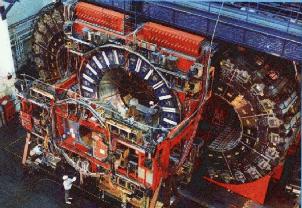 CDF
is a multinational experiment that studies collisions of protons and
antiprotons at Fermi
National Accelerator Laboratory . The CDF detector is sensitive to fundamental interactions
of quarks and leptons and to a variety of possible new phenomena. CDF began
operation in 1985. The detector has recently been substantially revitalized to take advantage
of increased luminosity in 2000.
CDF
is a multinational experiment that studies collisions of protons and
antiprotons at Fermi
National Accelerator Laboratory . The CDF detector is sensitive to fundamental interactions
of quarks and leptons and to a variety of possible new phenomena. CDF began
operation in 1985. The detector has recently been substantially revitalized to take advantage
of increased luminosity in 2000.
About Fermilab
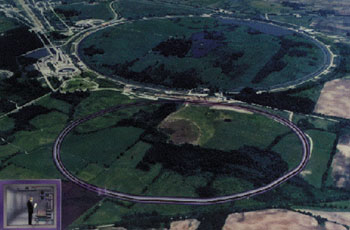 Fermilab
is located in Batavia, IL, about 2.5 hours south of Madison. Orginally constructed
around a 400 GeV proton accelerator for experiments with fixed targets,
the lab now accelerates protons and antiprotons to 1 TeV in a 4 mile circumference
superconducting synchrotron and operates primarily in colliding beam mode.
The collisions have the highest center-of-mass energy available at any
laboratory in the world at present and produce a large number of heavy
and unstable elementary particles. A new antiproton production
and injection system has recently been added to substantially increase the interaction
rate and improve studies of rare processes. Visit Fermi
National Accelerator Laboratory to take a virtual tour.
Fermilab
is located in Batavia, IL, about 2.5 hours south of Madison. Orginally constructed
around a 400 GeV proton accelerator for experiments with fixed targets,
the lab now accelerates protons and antiprotons to 1 TeV in a 4 mile circumference
superconducting synchrotron and operates primarily in colliding beam mode.
The collisions have the highest center-of-mass energy available at any
laboratory in the world at present and produce a large number of heavy
and unstable elementary particles. A new antiproton production
and injection system has recently been added to substantially increase the interaction
rate and improve studies of rare processes. Visit Fermi
National Accelerator Laboratory to take a virtual tour.
The Wisconsin CDF group has been active in the experiment since its inception. The group built and operated two forward and backward toroidal muon spectrometers to study b-quark and intermediate vector boson (W, Z) production and decay.
Wisconsin has recently constructed and installed new barrel shaped muon detectors (see BMU) and provided a cosmic ray test stand calibration of the new electromagnetic scintillating tile/fiber endplug calorimeters. The parity violating asymmetry in W<=>muon, neutrino observed with the toroids appears in
Measurement
of the Lepton Charge Asymmetry in W-boson Decays Produced in p anti-p Collisions
Published in Phys.Rev.Lett.81:5754-5759,1998.
 The CDF group
provides research appointments to students of particle physics who participate
in detector operation and data analysis. Interested students should contact
either Professor Carlsmith or Professor Pondrom. Recent WI theses are
The CDF group
provides research appointments to students of particle physics who participate
in detector operation and data analysis. Interested students should contact
either Professor Carlsmith or Professor Pondrom. Recent WI theses are
Measurement
of b anti-b rapidity correlations in p anti-p collisions at s1/2=
1.8 TeV.
By CDF Collaboration (F. Abe et al.). FERMILAB-PUB-98-392-E, Dec 1998.
34pp. Accepted for publication in Phys.Rev.D
Observation
of W+ W- production in anti-p p collisions at s1/2 = 1.8-TeV.
Published in Phys.Rev.Lett.78:4536-4540,1997
A database of CDF theses is available. General information about graduate study in particle physics at the University of Wisconsin-Madison may be found at the following links:
CDF publications describe
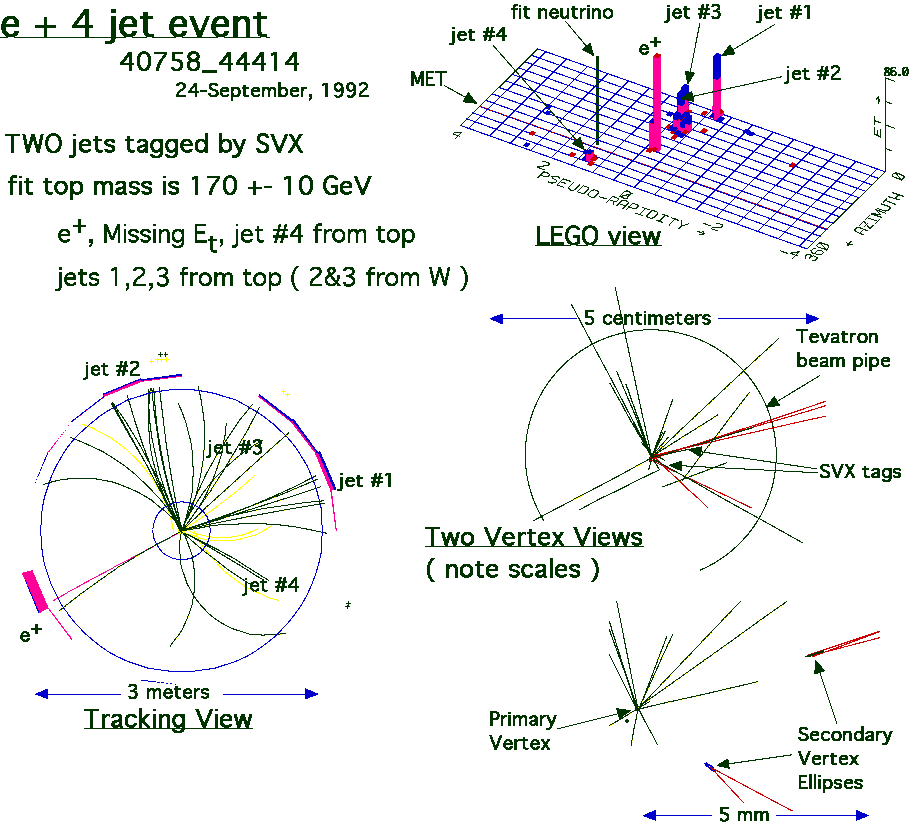
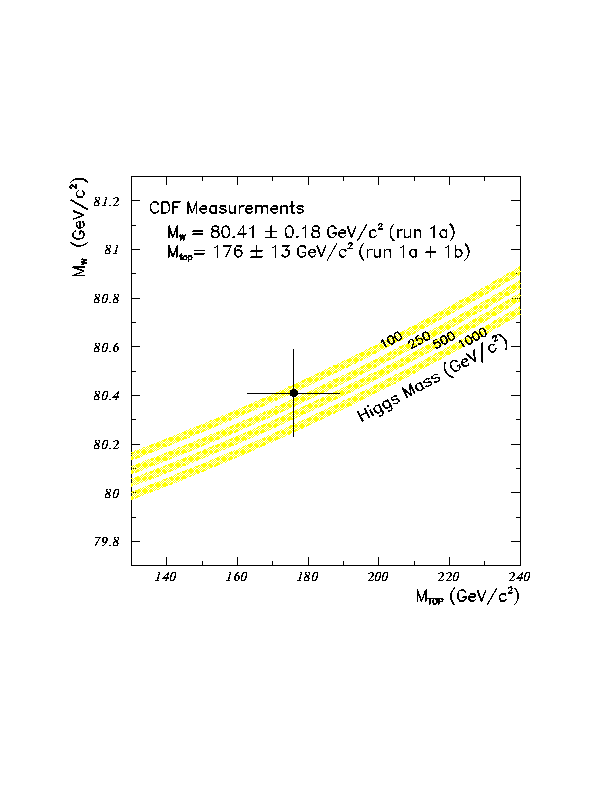
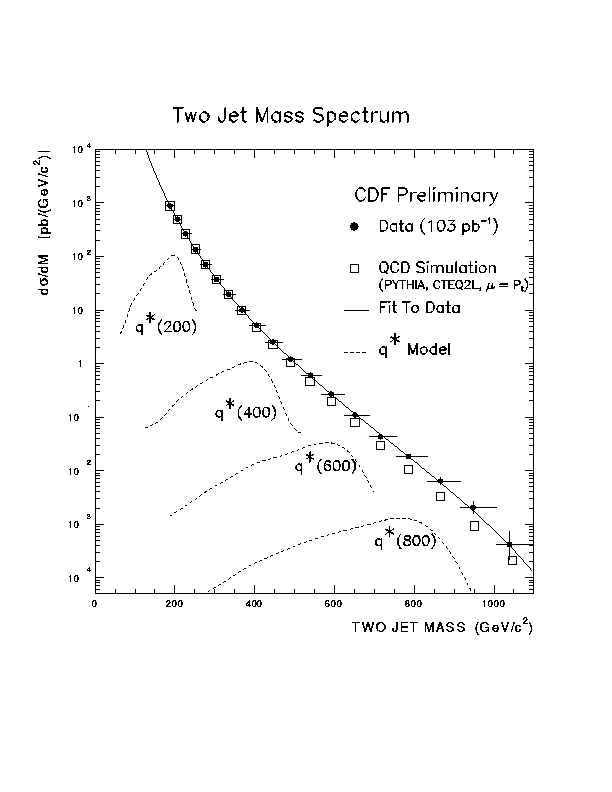
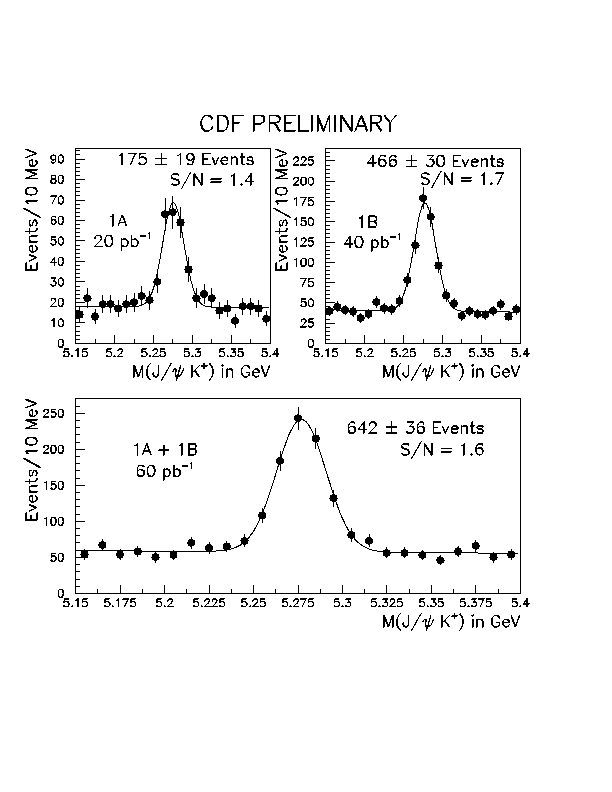
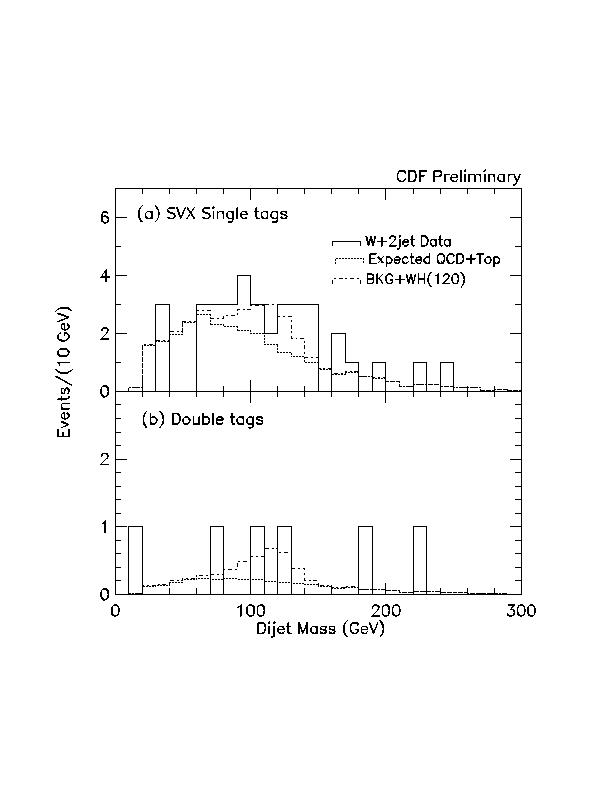
Links to recent results appear below. Click the image for a sample
plot. Click the name to go to the public home page of the corresponding
analysis group.
|
 |
 |
 |
 |